Description
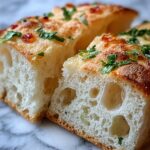
This ciabatta recipe yields two rustic, crusty Italian loaves characterized by their signature airy holes and golden brown crust. Using a slow-fermented sponge for deep flavor, the dough is wet and sticky, requiring gentle handling and baking with steam to achieve the perfect chewy texture and crisp exterior.
Ingredients
Scale
For the Sponge (Biga)
- 1 cup all-purpose flour
- ½ cup water (room temperature)
- ⅛ teaspoon active dry yeast
For the Dough
- All of the sponge
- 2 cups all-purpose flour
- 1 teaspoon salt
- 1 teaspoon sugar
- 1 teaspoon active dry yeast
- ¾ cup water (lukewarm)
- 1 tablespoon olive oil
Instructions
- Make the sponge: In a medium bowl, stir together 1 cup flour, ½ cup water, and ⅛ teaspoon yeast until combined. Cover and let sit at room temperature for 8–12 hours, or overnight, allowing fermentation to develop flavor and gluten.
- Prepare the dough: Add the sponge to a large mixing bowl with the remaining flour, salt, sugar, yeast, lukewarm water, and olive oil. Mix with a wooden spoon or dough hook until a sticky, wet dough forms. Knead using a stand mixer on medium speed for 7–8 minutes or by hand for about 10 minutes until elastic and very sticky.
- First rise: Cover the bowl with a clean towel and let the dough rise in a warm place for 1 ½ to 2 hours, or until doubled in size. This allows the dough to develop structure despite its high hydration.
- Shape the loaves: Lightly dust a clean surface with flour and gently turn out the dough, taking care to avoid deflating it. Divide into two equal portions and shape each into a rough oval or rectangle. Transfer the shaped dough onto a parchment-lined baking sheet, dust lightly with flour, and cover with a clean kitchen towel.
- Second rise: Allow the shaped loaves to rise again for 30–45 minutes until slightly puffed, which helps achieve the signature light texture inside.
- Preheat the oven: Heat the oven to 450°F (230°C). Place a baking stone or inverted baking sheet on a middle rack and a shallow pan on the lower rack to preheat, which will be used to generate steam for crust development.
- Bake with steam: Transfer the loaves on parchment to the hot baking surface. Quickly pour 1 cup of hot water into the shallow pan below to create steam. Bake for 20–25 minutes until the crust is golden brown and the loaves sound hollow when tapped, ensuring they are fully baked inside.
- Cool: Remove the loaves and cool completely on a wire rack before slicing to prevent a gummy texture.
Notes
- The dough is very wet and sticky, which is essential for the characteristic holes in ciabatta; avoid adding extra flour while kneading.
- For a richer flavor, refrigerate the shaped loaves for up to 12 hours and bake them directly from the fridge.
- Using steam during baking helps achieve a crisp, crackly crust typical of traditional ciabatta.
- Handle the dough gently to preserve the air bubbles formed during fermentation for a light crumb.